Nackter Tango
Breakthrough or Dam Burst?
by Arnold Voß · Tangodanza 3/2009
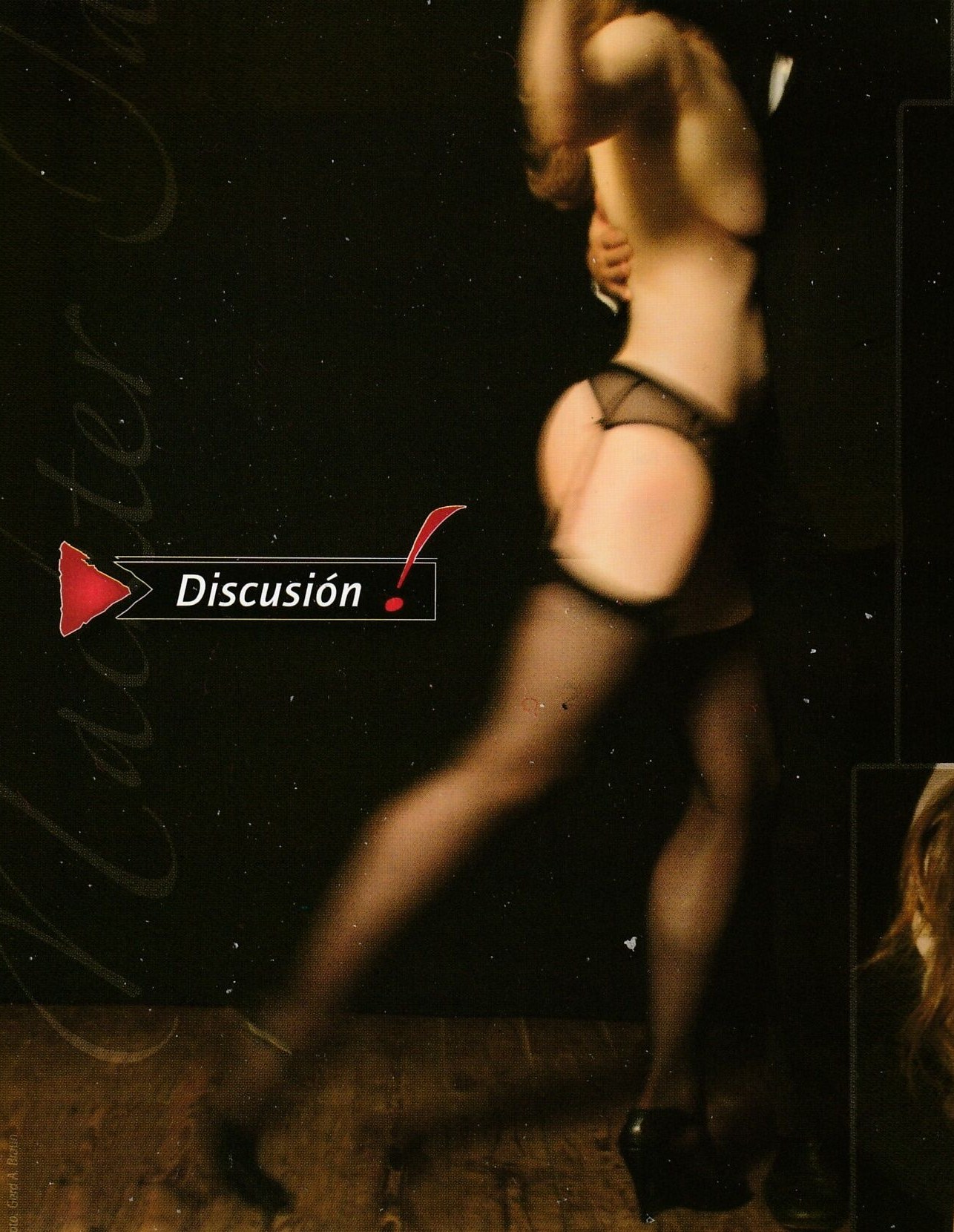
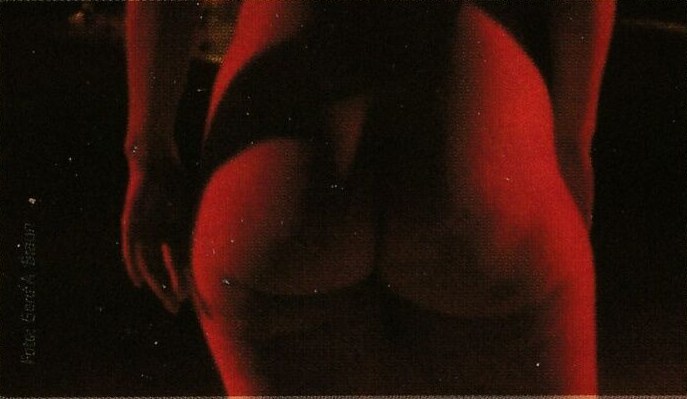
The event held in the Stuttgart area at the end of March under the label “Nackter Tango” caused quite a stir in the local tango scene. In the run-up it was advertised on the internet with unmistakable photos and texts: “A tango argentino event … in which the ‘whore-and-client game’ underlying tango argentino is celebrated openly in a unique way … which spans the arc from avowed sensuality, open eroticism and shamelessness to, yes: sex – in tension with the tango.” Dancing tango naked – the end of sensuality, or the beginning of a new, unclothed era in tango argentino? Thoughts on the matter from our author Arnold Voß.
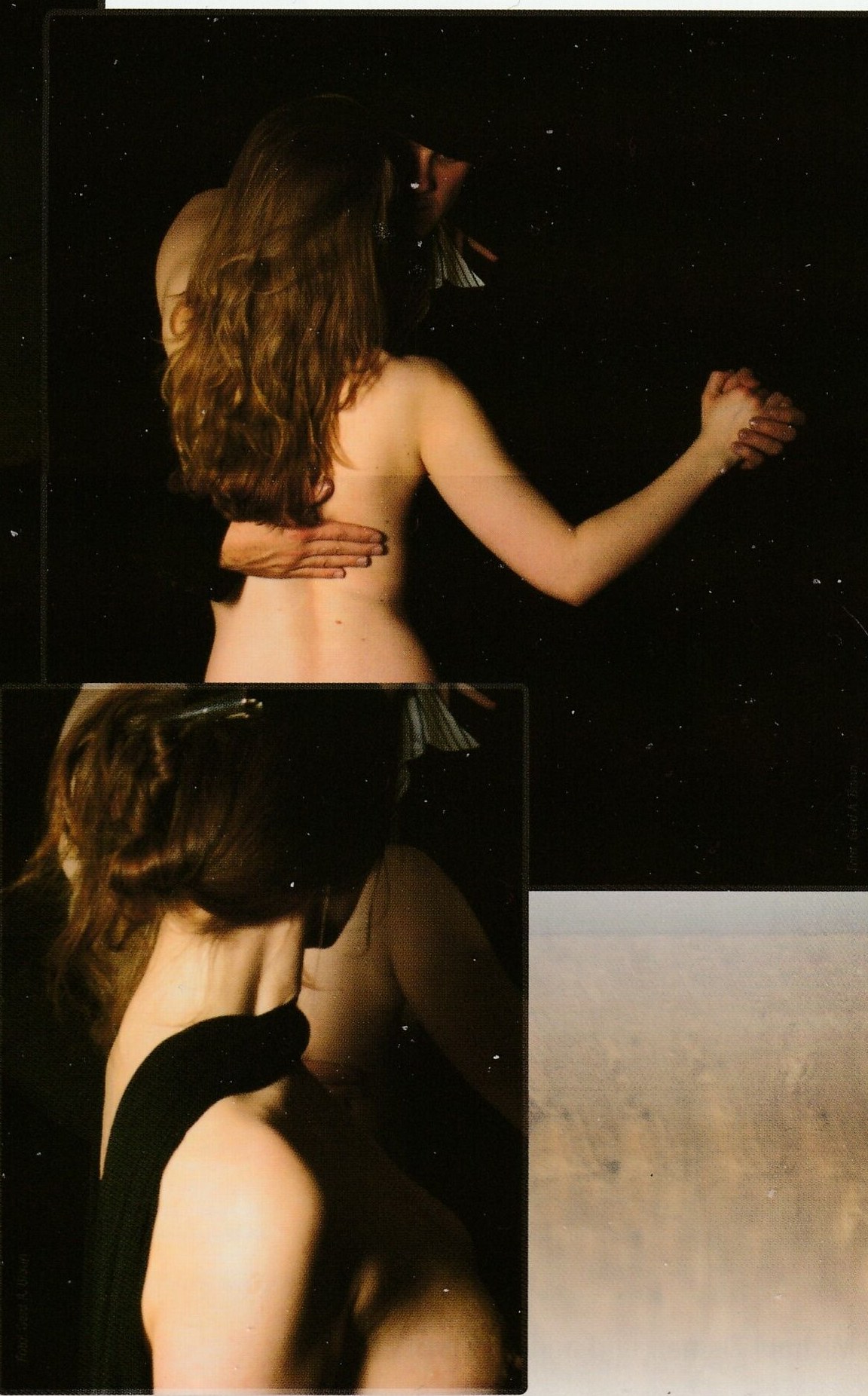
Yes, it is true: at the “Nackter Tango” event, the women danced “with nothing on”. At least during the show. But during the milonga of the same name, too, some tangueras dared to nestle against their partners at least “topless”, and most of them showed far more skin than usual. According to eyewitnesses, they did not look as if someone had forced or paid them to do it. In general the atmosphere is said to have been relaxed rather than tense. The tango was and remained the melodic and dancing centre of the evening. The orgiastic scenes that the event’s website had at least hinted at probably never happened – at least if one does not confuse cuddling, kissing and caressing with them.
Those who cried “Sodom and Gomorrah” will therefore have to fall eloquently silent again. And those who saw the fruits of women’s emancipation reduced to windfall should, in view of this quite straightforward and dance-aestheticized exhibitionism, at least start to ponder. Of course the question arises why only women were allowed – or rather wanted – to indulge in nudity. It must not go unmentioned in this context that – even if only very few – men were at least ready to lean their bare upper bodies against their female counterparts.
There are three possible answers. The first: because in its traditional core tango is about the beauty and eroticism of the woman, or more precisely about celebrating it in dance movement. The second might be: because men simply dare it less, or because the vast majority of them do not consider themselves beautiful enough. The third I will first formulate as a provocative conjecture: although men are generally less ashamed of their bodies than women, their inclination to exhibitionism is considerably smaller. Instead of “although” there could, however, also be a “precisely because”.
Now let us bring tango back into it, and the next question is obvious: is tango – clothed or not – not exhibitionism per se? At least when it is danced in public, which is the rule rather than the exception. Is that not even its point? For what would this art of rhythmic self-expression and staging, performed in a dialogue of two, be without spectators? What would this dance be without “voyeurs”?
And so we are already at the slit in the tango dress. Is it not there above all to open up views by opening itself in the movement? Does this play of opening and closing of the covering, of appearing and disappearing skin, not constitute the actual erotic appeal? And is that appeal not made possible in the first place by dance as movement?
This processual dialectic of being dressed and undressed, of clothing and unclothing, is also the core of every high-class striptease. One that, in its unavoidable and purposeful exhibitionism, joins the desire to show with the desire to hide, in order to be thrilling and aesthetic at the same time. One in which the journey is the destination, and complete nudity means climax and end at once, that is, relaxation. It is no coincidence that a striptease dancer vanishes exactly when she is bare of any clothing.
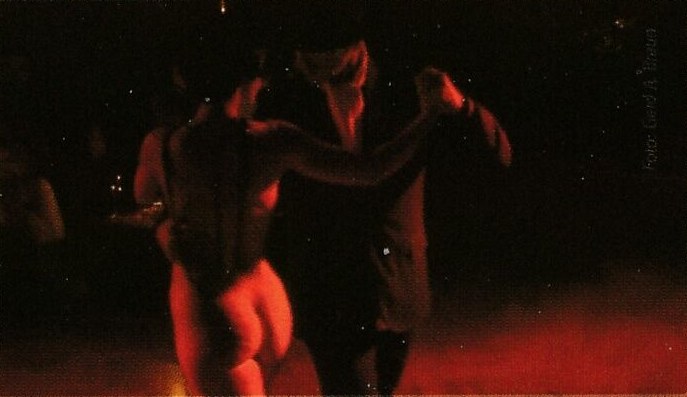
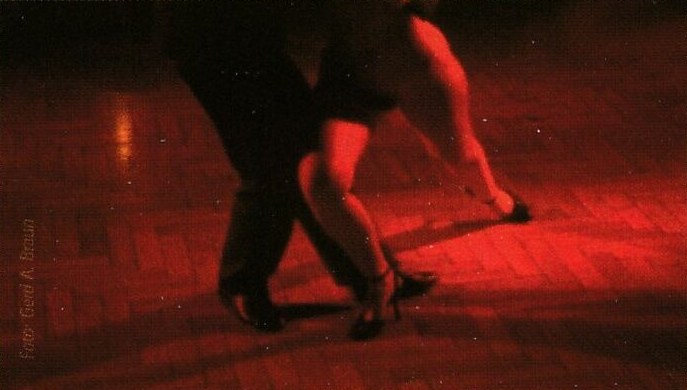
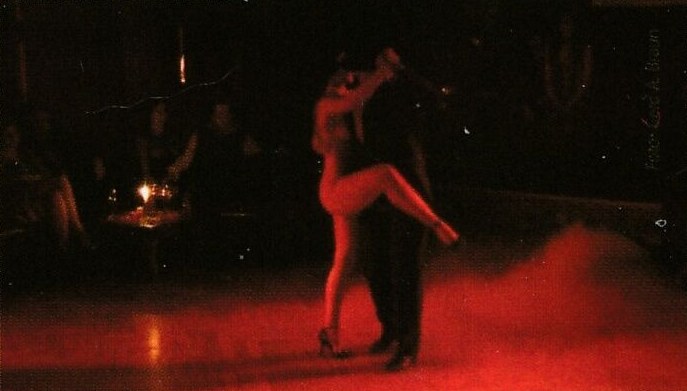
Let us once more take a curve towards our favourite pastime, and the next question arises by itself: is a well-danced tango, at least for the follower, not a kind of everlasting striptease? One that finds no end because it deliberately does not lead, or is not led, to complete nudity? Does this deliberately unintentional, partial dressing and undressing not create the real erotic tension between dancer and spectator, or stripper and voyeur? And of course also between the dancing couple themselves? Does this quasi natural and at the same time permanent game of covering and discovering naked skin, through the corresponding figures in ever new combinations, not make up the special sexual aesthetic of this dance?
I do not want to go on here about the corresponding effect of, say, the décolleté and other glimpses of similarly shaped female double curves. One question, however, arises inescapably from this dialectic of covering and revealing: can such an effect arise in the same or a similar way when the follower, buttoned up to the neck and wearing trousers, shows her or his erotic mobility? When only the pleasure of movement, not the pleasure of showing, determines the dance?
The neos will probably first shout a loud “Yes” to the latter. For the subdivision of this dance style that goes by “Aerobics-dances-tango” I would no longer be so sure. Here the connection between tango and sex seems to me to be denied altogether. With this way of interacting, based on constant distance, it would only be a disturbance anyway – or one does not notice it there at all, or only to a very limited degree. For these tangueras and tangueros the dance is obviously first of all sport, even acrobatics, and thus pure dynamics. They seem to find the constant embrace of the partners irritating rather than erotic. Their clothing and the rest of their outfit accordingly often comes across as sexless to androgynous. To be honest, with this kind of tango I could hardly imagine complete nudity as appealing. With the swinging, free-standing dynamics so fervently cultivated by these dancers, the completely unclothed and thus unsupported female breasts – especially from size M upwards – could no longer look erotic simply because they would inevitably, constantly and violently lose their statics, and with them their shapeliness.
Which leads without further ado to the next set of questions, which as a man I address above all to the female readers: how does it feel if, quite contrary to the position just described, you had to lean or even press your completely bare bosom against, say, a buttoned suit jacket (possibly of rough fabric)? And how is it, say, with an ocho? There, at least in milonguero style, chest rubbing against chest is inevitable. Is it not more pleasant to wear something, however thin and/or transparent, over it? Or does it all depend in the end on your counterpart? Whether you find the person likeable or not? And how well a woman is being led? Or what else does it depend on? I would be really curious to receive answers to this in the next Tangodanza.
Oh yes, and what about jealousy, when a stranger turns completely unclothed to your beloved man, nestles against him and lets herself be led by him, smiling blissfully? A question that could of course be put to the tangueros in exactly the same way – with the gender signs reversed. Is this feeling then even bigger, even more gnawing than it already is in such cases? Should couples therefore avoid such events as far as possible? Or dance there only with their own partner? Or does the “Nackter Tango” perhaps hold a very special “thrill” for couple eroticism, precisely under these circumstances, to change partners? From the male readers I naturally would like to know something about this. Is it a special erotic kick to dance, dressed, with a bare-breasted or even entirely naked woman? In high heels, of course? (I myself answer quite unabashedly and without much thought: “Yes.”) Can a man still concentrate entirely on the lead, or does the wish for tenderness and more win sooner or later? Does the direction not automatically move from the vertical to the horizontal? Does leading not inevitably turn into seduction? At least if you also like the tanguera very much and sense the same in her? Then, if both also want the same thing, would you not even like to leave the dance floor together, because exhibitionism cannot go that far after all? Does one not wish for something like a séparée?
As far as I know, the latter did not occur at the event in question. Possibly also because there were no such rooms there, and because with more than 70 dancers there were after all too many voyeurs. But anyone who thinks the story consistently through to its end will not be able to avoid thinking about exactly these possibilities of retreat and, if need be, offering them. Something that can be locked, of course, because for most people – whatever their sex – shame is still greater than the pleasure of showing. And there should be a mirror there, too. For behind closed doors shame, as is well known, decreases again and the pleasure of showing increases. And a bidet of white porcelain, no? For not only style should be kept up to the very end. The option of returning to the dance floor unnoticed, in the same outward condition in which man and woman “disappeared” from it, should be part of the concept of this form of dance encounter.
But the organisers probably did not want to go that far, to be that consistent. At least not the first time. As courageous as it was of them to open this form of tango intimacy – hitherto reserved for private events, and which of course – as insiders know – has existed for a long time – to the public, they obviously did not want to overtax the tango community either. There had been discussions about it on the internet beforehand, and the opinions expressed there were by no means only positive. Seen this way one can – however one stands on “tango morals” – speak of a great success. And of course, depending on the perspective, of a breakthrough or a dam burst.
For at the “Nackter Tango” nothing more and nothing less was done than to help the erotic tango myth become reality, that is, to transform personal dreams and wishes from the world of desire into the world of action. And indeed of shared and public action, not of private and hidden action as, for instance, in the wonderful little book Der Tangoengel, where it is described at length to the point of pain. Nudity as a natural part of dance eroticism, which is at the same time celebrated and staged as a collective festival. Which is lifted out of the intimacy of seclusion and thereby becomes shameless. Which in its voluntariness can also mean liberation. Which at the same time presents itself with style by submitting to the ritual of the dance, its elegance and its grace.
That is why the comparison with a high-class swingers’ club or brothel is wrong from the start. So is the use of the categories of pornography, unless it raises itself to art. It is rather a new, sociocultural and socio-aesthetic stage of tango argentino, which in this case not for nothing played with its legends of origin. However contrived and clichéd this may have appeared on the website of the event in question, this event at least opens up to the receptive part of the tango community the possibility of (self-)realisation that those concerned have probably been waiting for for a long time. Which they have so far had to or wanted to practise more or less in hiding. Not because their behaviour was illegal or immoral, but because they feared the reaction of the majority and of the public tango opinion represented by it.
So one may look forward with suspense to what develops from this and which new events and dance formats will emerge for the tango scene and beyond. Above all, though, one may be curious how the wider public will react once the whole thing falls into the clutches of the tabloids and trash TV. But the upper-class arts pages, too, will tear it to pieces – albeit intellectually. And our tango researchers will face a new riddle all the more.
In this spirit, I wish all those who want to take the “Nackter Tango” further above all one thing: respect – and namely from those who see their efforts rather as a threat than as an enrichment.
From: Tangodanza, no. 3/2009, pp. 24–26 (translated from the German original) · Original German article as PDF (Tangodanza 3/2009)